
TL;DR: For a quick answer, take a photo and let an app estimate the weight (Pocket Scale does this on iPhone and Android). For heavy things, subtract your own weight on a bathroom scale. For small things, compare them with coins or butter. For anything that has to be exact, borrow a real scale.
You can get a usable weight without a scale in under a minute. The method depends on how heavy the item is and how close you need to be. A photo estimate or a comparison with a known object is enough for a recipe, a bag for the airport or a rough postage guess. It is not enough for medicine or anything sold by weight.
1. Take a photo and get an estimate
This is the fastest option when you have your phone and nothing else.
Pocket Scale is a free app for iPhone and Android that estimates the weight of an item from a photo. You do not need a scale, a barcode or an account. The app looks at the item in the frame, including its size, shape and material, and returns an estimated weight in grams and kilograms or ounces and pounds.
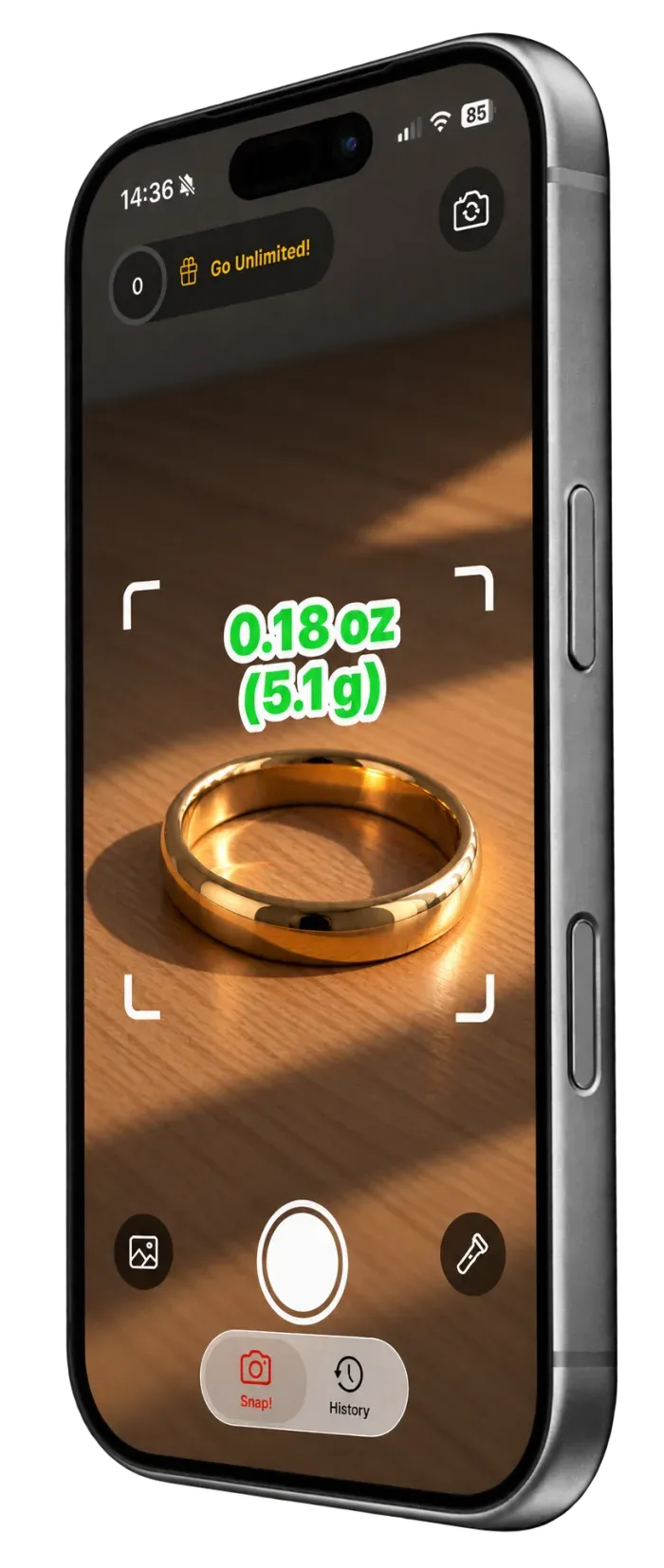
Pocket Scale’s camera view with the estimate shown over a gold ring: 0.18 oz (5.1 g).
How to use it:
- Open the Snap! tab and point the camera at the item, or choose a photo from your library.
- Tap the shutter button. The result shows the estimated weight, a min to max range and a confidence level.
- Check the result later in History, where every weigh-in is saved on your phone and can be searched.
A few more things worth knowing:
- Quick Snap. The in-app camera has a framing guide and lets you take several photos in a row. Each one is processed on its own, so you can line up a counter full of items and weigh them one after another.
- Units. Pick metric or imperial when you set up the app, and change it later in Settings.
- Free and paid. The app is free to download and includes a few free weigh-ins each week. Premium is an optional subscription that removes the weekly limit.
- Privacy. There is no account, name or email. Photos are sent to our server only to produce the estimate and are not stored afterwards.
Tip: Frame the whole item from top to bottom, use natural light, keep the background plain and hold the phone steady. A clear photo of one item gives a better estimate than a cluttered shot of five.
The estimate is a guess based on what the photo shows, so it works best for common, recognizable things and gets weaker for unusual or dense objects, where size says little about weight. Treat the range as the honest answer, not just the middle number.
Download Pocket Scale for iOS or Android.
2. Use a bathroom scale and subtract
If the item is heavy enough, you already own a scale.
- Step on the bathroom scale and note your weight.
- Pick up the item, step on again and note the new weight.
- Subtract the first number from the second.
This works for luggage, boxes, a bag of cat litter or a small appliance. It does not work for small things: bathroom scales are built for body weight, so they round to fairly coarse steps. Anything under roughly a kilogram disappears into that rounding. Stand in the same spot both times and keep your balance steady.
3. Compare with something you know the weight of
Some everyday objects have a fixed, published weight. Holding the item in one hand and a reference in the other tells you which is heavier, and by roughly how much.
| Reference | Weight |
|---|---|
| US nickel | 5 g |
| US quarter | 5.67 g |
| US penny (since 1982) | 2.5 g |
| Stick of butter (US) | 4 oz (113 g) |
| 1 liter of water | about 1 kg |
| 1 milliliter of water | about 1 g |
Sources: coin weights from the US Mint’s coin specifications; butter from the 113 g (4 oz) net weight on a US stick’s wrapper and King Arthur Baking’s ingredient weight chart; water from the USGS, which gives its density as about 1 g per milliliter.
Water is the most useful one. If you can measure a volume, you can estimate the weight of a liquid, and many things in a kitchen are close to the weight of water for their size. A US cup of water is about 237 g (a US cup is about 237 ml). King Arthur Baking’s chart rounds it to 227 g.
This method is slow and imprecise. It is good for deciding whether something is closer to 50 g or 500 g, not whether it is 52 g or 58 g.
4. Build a simple balance
A balance compares two weights directly, which makes it more accurate than judging by hand.
Hang a coat hanger or ruler from a string so it hangs level. Put the item in a small bag or cup on one side and a matching bag on the other. Add coins or other known weights to the second side until the beam sits level again. Count up the weights and you have the item’s weight.
The result is only as good as your reference weights and how level your pivot is. Use a stable beam, keep both bags the same distance from the center and add weights slowly. For small items, a ruler with a pencil as the pivot is enough.
5. Read the label or look it up
Many things already say how much they weigh. Packaged food shows a net weight. Electronics and appliances list a weight in the manual or on the product page. Shipping boxes and carrier supplies often print their weight limit.
If you are weighing something to ship it, you can also look up the product online, then add the weight of the box and the filling. Carriers charge by weight bands, so a close estimate is usually all you need to pick the right service.
Which method should you use?
| Situation | Best method |
|---|---|
| A quick guess, any size, phone in hand | Photo estimate |
| A suitcase, box or heavy bag | Bathroom scale and subtract |
| Something small and light | Compare with coins or butter |
| A recipe ingredient in grams | Photo estimate, or a balance |
| A packaged product | Read the label |
| Medication, supplements, legal sales | A certified scale only |
When to use a real scale
Every method above is an estimate. Use a certified scale for anything where an error matters: dosing medication or supplements, weighing ingredients for a recipe where precision changes the result, selling goods by weight, or checking an airline or postal limit when you are close to the cutoff. A basic digital kitchen scale costs little and is accurate to a gram or better.
Frequently asked questions
How can I weigh something without a scale?
Take a photo and use an app that estimates weight from a picture, subtract your weight on a bathroom scale for heavy items, compare the item with objects of a known weight, build a simple balance, or read the weight off the label.
Can a phone camera really weigh things?
A phone camera cannot measure weight directly. An app can estimate it by recognizing the item and judging its size, shape and material from the photo. Pocket Scale does this and shows a min to max range, so you know the result is an estimate and how wide the uncertainty is.
How accurate is a weight estimate from a photo?
It depends on the photo and the item. Clear, well-lit photos of one common item give the best results. Dense, hollow or unusual objects are harder, because their size says less about their weight. Use a physical scale when you need an exact figure.
How do I weigh food without a kitchen scale?
For liquids, measure the volume: 1 milliliter of water weighs about 1 gram. For solids, use a photo estimate or compare with a known item, such as a US stick of butter at 113 g. For baking, where small differences matter, a real scale is worth it.
Is Pocket Scale free?
Pocket Scale is free to download on iPhone and Android and includes a few free weigh-ins every week. Premium is an optional in-app subscription that adds unlimited weigh-ins.